Rules of the Real World · Book one
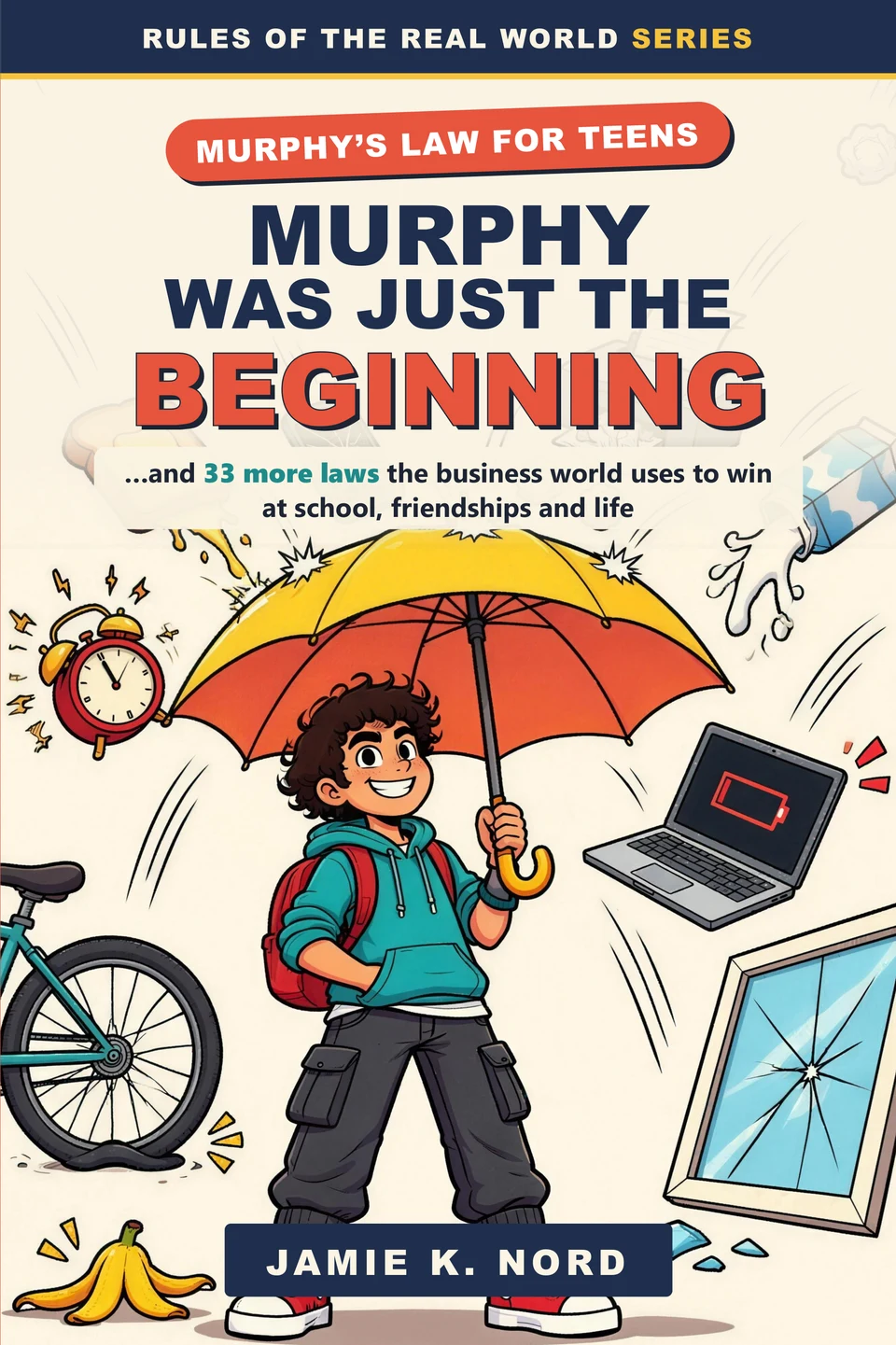
Murphy Was Just the Beginning
Murphy's Law for Teens and 33 More Laws the Business World Uses to Win at School, Friendships and Life
Grown-ups at work have a secret cheat sheet. It's a set of "laws" with funny names, like Murphy's Law, Parkinson's Law and Hanlon's Razor, that explain why projects run late, why group chats explode and why smart people make bad decisions.
Most adults learn them the hard way. Your teen can learn them now.
How every chapter works
One law. Five minutes. It clicks.
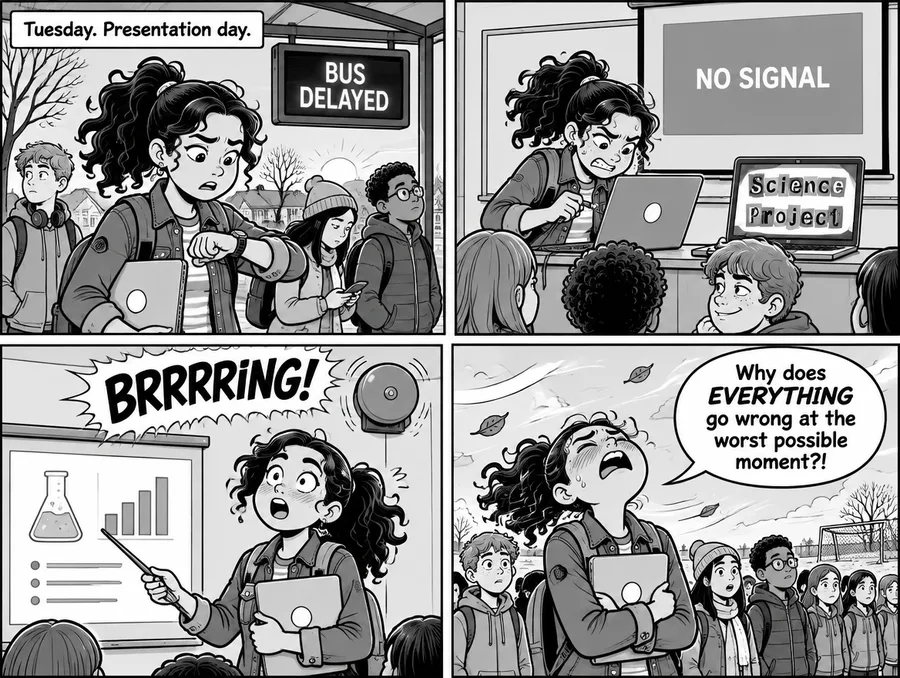
- A comic strip and a teen story from school, friends and home.
- A true story of famous companies caught by the same law, from Tesla's shattered "unbreakable" window to Microsoft's four-day week.
- A toolkit of simple moves to use this week.
- A quick challenge plus a question to talk about together.
Written in a friendly, never-preachy voice. No more "why me?" moments.
The cheat sheet
All 34 laws, in one place.
Five parts, from beating deadlines to bouncing back. Want it on your wall? Get the free poster.
Part 1: Deadlines and Projects
- Murphy's Law: Anything that can go wrong will go wrong, so plan for it.
- Parkinson's Law: Work grows to fill the time you give it.
- Hofstadter's Law: It always takes longer than you expect, even when you allow for this law.
- The Planning Fallacy: We plan for the best case, not the likely case.
- Student Syndrome: Extra time gets wasted; we start at the last minute anyway.
- The Pareto Rule (80/20): About 20% of the effort brings about 80% of the result.
- The Eisenhower Matrix: Urgent isn't the same as important.
- Brooks's Law: Adding people to a late project makes it later.
Part 2: Measuring and Improving
- Goodhart's Law: When a number becomes the goal, it stops measuring what matters.
- The Dunning-Kruger Effect: Beginners often feel more sure than they should; experts often feel less.
- The Sunk Cost Fallacy: What you've already spent shouldn't decide what you do next.
- The Peter Principle: Being great at one job doesn't mean you'll be great at the next one.
- Kaizen: Small daily improvements beat big rare efforts.
- Survivorship Bias: We see the winners, not everyone who tried and failed.
- The Post-Mortem: Look at what went wrong without blaming anyone.
Part 3: People and Teams
- Hanlon's Razor: Don't blame on meanness what a mistake can explain.
- The Mehrabian Rule (and Its Limits): Tone and body language carry feelings, but not facts.
- The Ringelmann Effect: The bigger the group, the less each person puts in.
- The Abilene Paradox: A group can agree to something nobody actually wanted.
- The Halo Effect: One shiny trait makes everything else about a person look shinier too.
- Reciprocity: When someone does something nice for you, you want to do something nice back.
Part 4: Decisions and Risk
- Occam's Razor: The simplest explanation is usually the right one.
- The Pre-Mortem: Imagine it already failed, then ask why.
- Second-Order Thinking: Always ask “and then what?”
- Opportunity Cost: Every yes is a no to something else.
- Confirmation Bias: We look for proof of what we already believe.
- Anchoring: The first number you hear sets the deal.
- Choice Overload (Hick's Law): More options make it harder to decide.
Part 5: Growth and Bouncing Back
- Kidlin's Law: Write a problem down clearly and it's half solved.
- The Matthew Effect: Small early advantages grow over time.
- Diminishing Returns: Past a certain point, more effort adds less.
- Fail Fast: Small, cheap failures beat one big, late failure.
- The Streisand Effect: Trying to hide something draws more attention to it.
- The Peak-End Rule: People remember the best (or worst) moment and the ending.
Book details
- AuthorJamie K. Nord
- Reading age11 to 14 years
- FormatPaperback, 6 × 9 in, illustrated
- PublishedDecember 2026